
Warranties & guarantees
A ten-year warrantyis not ten years of free repairs.
Manufacturer coverage pays for the part. It does not pay the technician who diagnoses the failure, recovers the refrigerant and spends most of a day fitting the replacement. That gap is where warranty disappointment lives, and almost nobody explains it before you sign.
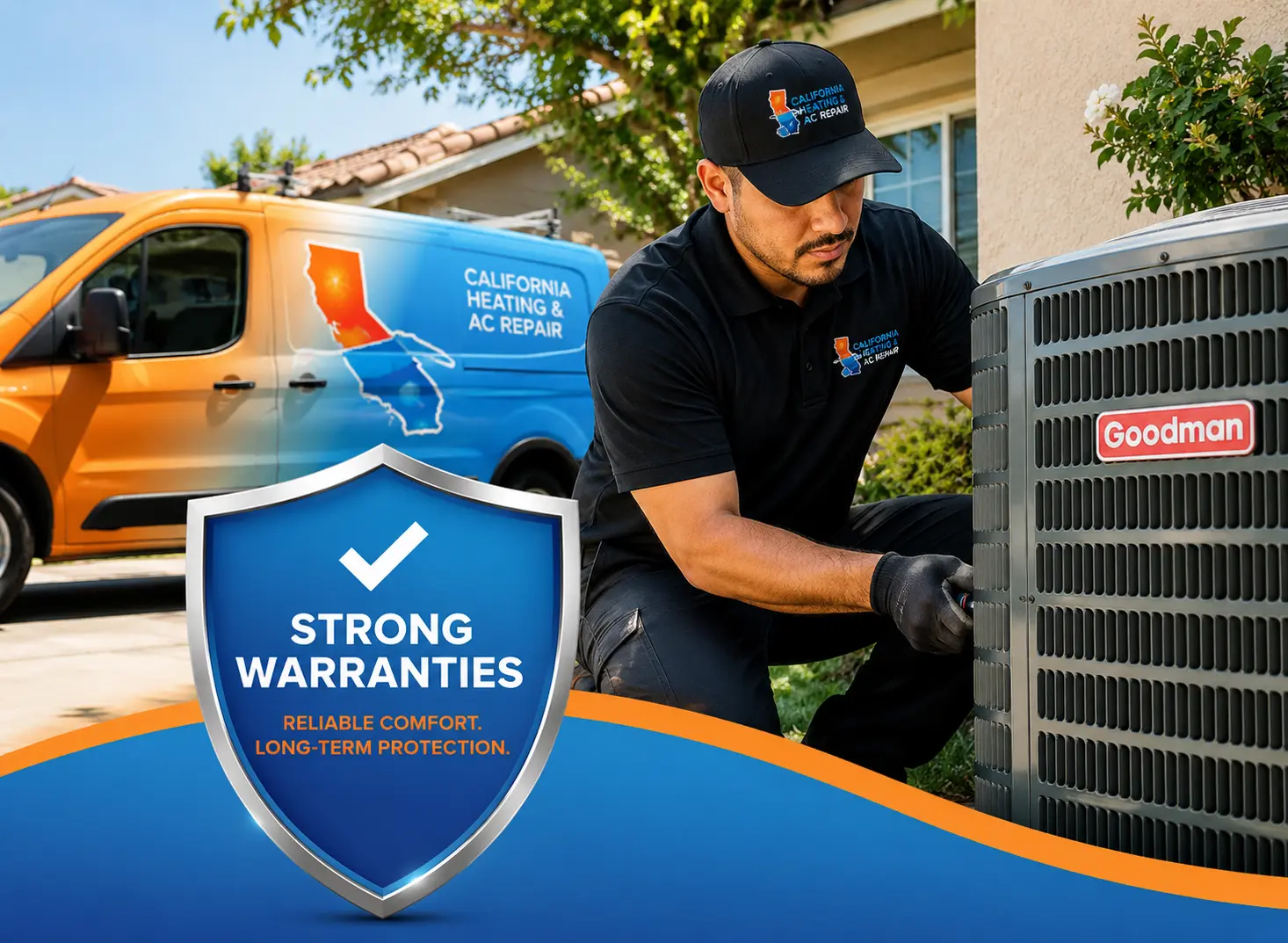
The gap nobody mentions
Parts are covered. Labor usually is not.
Manufacturer warranties on residential HVAC equipment commonly run around ten years on parts for registered systems. That number gets quoted a lot during a sale, and it is genuinely worth having.
What it means in practice is narrower than it sounds. If a compressor fails in year eight, the manufacturer ships a replacement compressor. It does not pay for the diagnosis, the refrigerant recovery, the labor to swap it, the evacuation, the new charge or the testing afterward — and on a compressor that is most of the cost.
The manufacturer covers the part. Whether anyone covers the labor depends entirely on the contractor, and that is the question worth asking before you buy.
Three separate layers of coverage
People tend to think of "the warranty" as one thing. It is three, from three different parties, with three different scopes.
1
Manufacturer parts warranty
From the equipment maker
Covers defective components for a set term, commonly around ten years on registered residential equipment. Compressors and heat exchangers sometimes carry longer or separate terms.
Covers: the replacement part. Does not cover: the labor to diagnose or install it, refrigerant, or the service call.
2
Contractor labor warranty
From the company that installed it
Covers the labor to put right a covered failure, and this is the layer that varies most between companies. It is also the one most quietly left out of a cheap quote.
Covers: the technician's time on qualifying work. Ours: 1 year standard, extending to 10 years while we handle your annual maintenance.
3
Workmanship guarantee
From the company that installed it
Distinct from a labor warranty. This covers the installation itself — the connections, the charge, the airflow, the duct transitions — rather than a manufacturing defect in the equipment.
Covers: problems caused by how it was installed. Matters because: most early HVAC failures are installation issues rather than bad equipment.
What that looks like on a real failure
A compressor gives out in year eight on a system with a registered ten-year manufacturer warranty and no labor coverage.
Compressor failure, year eight
The compressor itself
Covered by the manufacturer. Supplied at no charge, assuming the equipment was registered and the failure qualifies.
The diagnostic that found it
Not covered by the manufacturer. Somebody has to establish the compressor is the failure before a warranty claim can be made at all.
The labor to replace it
Not covered. Recovering refrigerant, removing the old compressor, brazing in the new one, evacuating the system and recharging it is most of a day's work.
Refrigerant and consumables
Not covered. Depending on refrigerant type this alone can be a significant line on the invoice.
The part was free. The repair was not. This is the single most common reason homeowners feel misled by a warranty they were told was comprehensive.
What quietly reduces or voids coverage
Manufacturer terms vary, so always read yours. These are the conditions that catch people out most often.
-
The equipment was never registered
This is the big one. Most manufacturers require registration within a window after installation, and unregistered equipment typically drops to a substantially shorter base warranty. It costs nothing to do and gets forgotten constantly.
-
It was installed by an unlicensed contractor
Warranty terms generally require installation by a properly licensed professional. Work done outside that is difficult to defend when a claim is made years later.
-
No permit was pulled
Unpermitted installation undermines a warranty claim and creates problems well beyond it. More on permits and code compliance.
-
There is no maintenance record
Many manufacturers require documented annual maintenance. When a compressor fails at year seven and nobody can produce a service history, that becomes the manufacturer's reason to look harder at the claim. A maintenance plan keeps the paperwork.
-
The installation itself caused the failure
Incorrect charge, poor airflow or a badly matched system will kill equipment early, and manufacturers do not cover damage caused by installation error. This is exactly why sizing and commissioning matter more than the badge on the box.
-
The equipment was relocated or modified
Moving equipment after installation, or altering it outside the manufacturer's specification, commonly falls outside coverage.
The forgotten step
Registration is free and half of systems never get it done
Most manufacturers require the equipment to be registered within a set period after installation to unlock the full parts warranty. Miss the window and coverage typically falls back to a much shorter default term.
It takes a few minutes and costs nothing. It is also nobody's job unless somebody makes it their job, which is why so many Fresno systems are sitting on half the coverage their owners believe they have.
How to check your own coverage
- Find the data plate on the outdoor unit and note the model and serial numbers.
- The serial usually encodes the manufacture date, which sets the clock on coverage.
- Registration status is held by the manufacturer and can be looked up against those numbers.
- Or text us a photo of the plate on (559) 520-4240 and we will check it for you, whether or not we installed it.
What we commit to
Specific, checkable things we do on every installation — not adjectives about peace of mind.
We register your equipment
Filed inside the manufacturer's window, so your parts coverage is the full term rather than the shortened default.
You get it in writing
Manufacturer terms and our own coverage handed to you as documents, before the job rather than after.
We protect the claim
Permit pulled, install verified, commissioning documented — the things a manufacturer asks about when a claim is made years later.
Our labor warranty on installations
1 to 10 yearsCovering the technician's time on qualifying warranty work
Standard
1 year
Included on every system we install, in writing, with no conditions attached.
Extended
Up to 10 years
Stays in force for as long as we are the company performing your annual maintenance.
We are telling you the condition up front rather than in the small print. See what the annual service covers.
Why it is tied to the maintenance
Because most labor claims are preventable, and the two things that kill a system early — a dirty condenser and a drifting refrigerant charge — are exactly what an annual service catches. A company standing behind ten years of labor needs to know the system was actually looked after.
It also means the coverage stays honest. We are not promising a decade of free labor on a system nobody has touched since installation day, because no company can deliver that and stay in business. This version we can actually honor.
Five questions before you sign
Ask every company quoting your replacement, including us. The answers separate quotes that look similar on price.
-
"Is there a labor warranty, and for how long?"
The manufacturer covers parts. If nobody covers labor, a warranty repair in year eight still lands on you.
-
"Will you register the equipment, and can I see confirmation?"
Free to do and easy to forget. Ask for proof rather than an assurance.
-
"Do you have a separate workmanship guarantee?"
Equipment defects and installation defects are different problems. Find out whether both are covered and by whom.
-
"Does the warranty require annual maintenance?"
Many do. Worth knowing on day one rather than discovering it during a claim.
-
"Can I have all of this in writing before I decide?"
A verbal warranty is not a warranty. If a company is reluctant to put terms on paper, that reluctance is the answer.
Comparing quotes
Two quotes, same equipment, very different coverage
Warranty terms are one of the biggest hidden differences between replacement proposals, and they rarely appear on the first page. If you have a quote in hand, we will look at what it covers alongside our own diagnostic and tell you what is missing. Free, no obligation.
Warranty questions
Does my manufacturer warranty cover labor?
Generally no. Manufacturer warranties cover the replacement part. The diagnosis, labor, refrigerant and service call are separate, and whether they are covered depends on the contractor's own labor warranty.
How do I know if my equipment was registered?
Registration status is held by the manufacturer against your model and serial number. Text a photo of the data plate on your outdoor unit to (559) 520-4240 and we will check it for you, even if another company installed the system.
Will using a different company void my warranty?
No. Manufacturer warranties require a licensed contractor and proper installation, not one specific company. You are free to have anyone qualified service the system.
How does your 1 to 10 year labor warranty work?
Every system we install carries a one-year labor warranty with no conditions. That extends up to ten years for as long as we are the company performing your annual maintenance — if the yearly service lapses or moves to another company, the coverage returns to the standard term. Full written terms come with your quote. See the maintenance plan.
Does skipping maintenance really affect a warranty claim?
It can. Many manufacturers require documented annual maintenance, and a claim with no service history behind it gets more scrutiny. Our maintenance plan keeps that record.
Is the warranty transferable if I sell the house?
It depends on the manufacturer and sometimes on a transfer fee and a deadline after the sale. Check your specific terms, because it is a genuine selling point when it does transfer.
What if my system was installed without a permit?
It weakens a future warranty claim and creates problems at resale. Retroactive permitting is usually possible and far easier to handle now than during a sale. More on permits.
Get a quote with the coverage spelled out
Manufacturer terms, our labor warranty and the workmanship guarantee, in writing, before you decide.
Manufacturer warranty terms are set by the equipment maker and vary by brand, model and registration status. This page describes how HVAC warranty coverage generally works and is not a substitute for the written terms supplied with your equipment and your installation agreement. California Heating & AC Repair is operated by Craftline Renovations, Inc. · CSLB License #999179 · Licensed and insured.