
System sizing
Matching the old tonnageis not sizing.
The size of your next system should come from a calculation of what your house actually needs, not from reading the label on the unit that just failed. Oversizing is the most common installation error in this valley, and it costs you every month it runs.
How sizing usually happens
Someone reads the old label and writes down the same number
It takes about four seconds. It requires no measurement, no math and no time in your attic. And it feels perfectly reasonable to everyone involved, because the old system was presumably sized correctly when it went in.
Except it very often was not. Sizing by matching means whatever mistake was made the first time gets carried forward for another fifteen years — and if the previous installer went a size up to be safe, the next one inherits it and sometimes goes up again.
Your house has changed since the last system went in. New windows, added insulation, a re-roof, an addition. The right size today is a question, not a label.
Three ways a contractor picks a size
Only one of them involves your actual house. It is worth knowing which you are getting before the quote arrives.
Least accurate
Match the old unit
Read the tonnage off the failed condenser and order the same. No measurement, no assessment, and it perpetuates whatever error is already in place. This is the most common method in the industry and the reason so many Valley homes are running oversized equipment.
Rough guess
Square footage rule of thumb
A ton of cooling per so many square feet. Quick, and it ignores everything that actually determines load — which walls face west, how much glass you have, what is in your attic, and how leaky the ducts are. Two identical-sized Fresno homes can need genuinely different equipment.
The right way
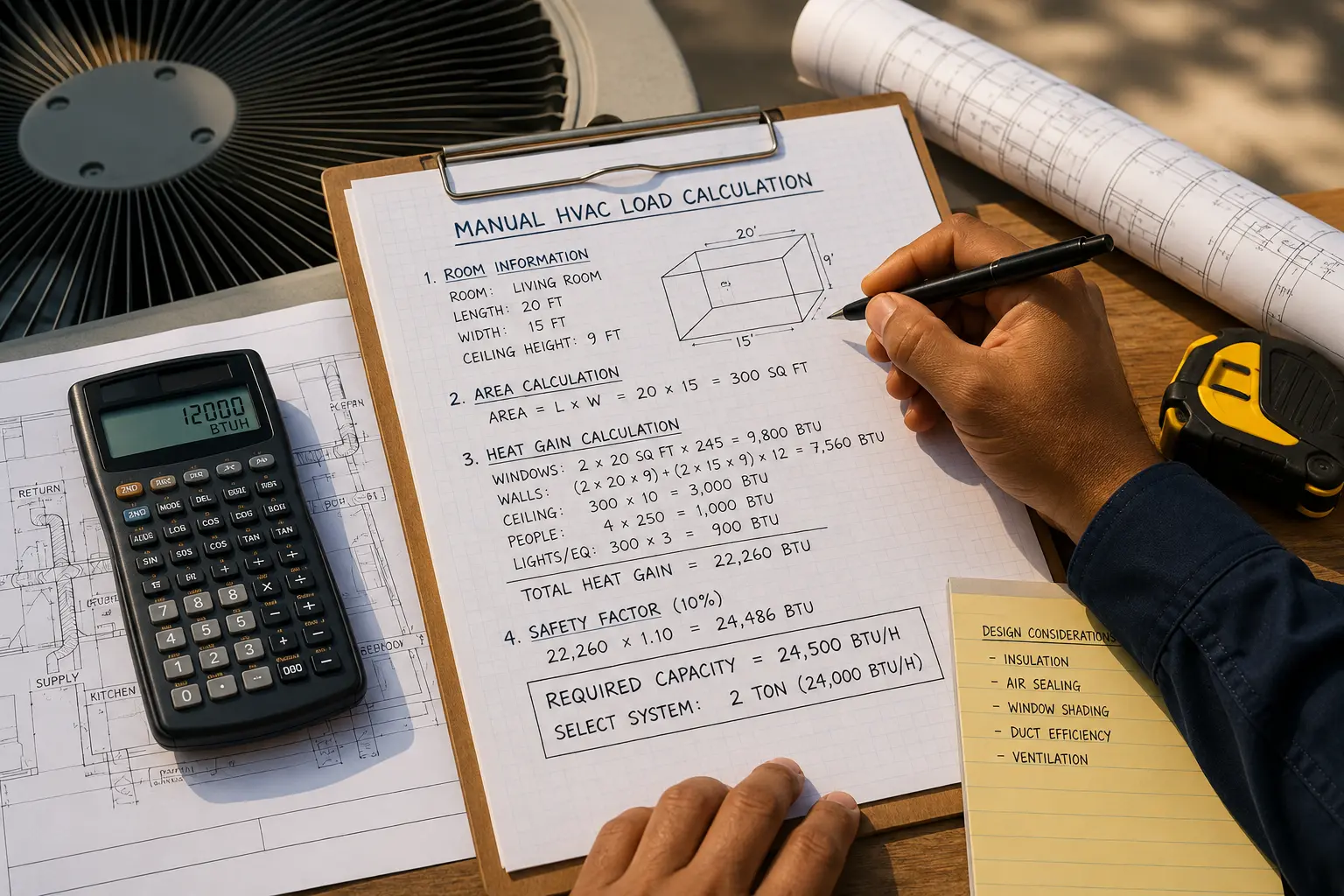
A Manual J load calculation
The industry standard method, published by ACCA. It calculates how much heat your specific house gains and loses using its real construction, orientation, glazing, insulation and local design conditions. It takes real time to do, which is precisely why it often gets skipped.
What a load calculation actually measures
None of this is guesswork, and none of it can be read off the side of your old condenser.
- OrientationWhich walls and windows face west matters enormously in Fresno. Afternoon sun on a west-facing wall of glass is a very different load from the same wall facing north.
- GlazingWindow area, glass type, and whether there is shading. Older single-pane glass and modern low-E windows behave nothing alike.
- InsulationAttic, wall and floor insulation levels as they actually are today, not as they were when the house was built.
- Air infiltrationHow much outside air leaks in. A tight newer build and a 1955 tract home with original weatherstripping are different machines.
- Duct location and conditionDucts running through a 150-degree Fresno attic add load before the air ever reaches a room. Leaky ducts add more.
- Internal gainsPeople, appliances, lighting and anything else generating heat inside the envelope on a summer afternoon.
- Local design conditionsThe outdoor temperatures the system is designed to handle for this specific part of the Central Valley, not a national average.
- Room-by-room loadNot just a whole-house number. Which rooms need how much air is what determines whether the back bedroom is comfortable.
The load calculation is the first step. Equipment selection against that load and duct design to deliver it are separate calculations again — and skipping either one undoes the work of the first.
Why bigger is not safer
Oversizing feels like insurance. In practice it is the error that causes the most complaints, and it is nearly impossible to fix afterwards without replacing the equipment again.
-
It short cycles
An oversized system satisfies the thermostat quickly, shuts off, and restarts a short while later. Compressors and contactors wear on starts more than on run time, so the system that was supposed to last longer wears out sooner.
-
Comfort gets worse, not better
Short bursts of very cold air with long gaps between them produce bigger temperature swings and worse room-to-room evenness than a correctly sized system running longer, steadier cycles. Bigger equipment routinely makes a house feel less comfortable.
-
It never reaches steady state
An air conditioner is least efficient in the first minutes after start-up. A system that only ever runs short cycles spends a disproportionate amount of its life in that inefficient window, which shows up on the PG&E bill.
-
The ducts probably cannot handle it
Larger equipment moves more air, and duct systems designed for the original load choke on it. High static pressure follows, and that damages blowers and undermines the capacity you paid extra for.
-
You paid more for the privilege
A larger system costs more to buy, more to run and often more to repair. Oversizing is the only common installation error that charges the homeowner extra for the mistake up front.
The Fresno part
Systems are sized to design temperature, not the record high
Load calculations use a design temperature — a figure representing the hot conditions your system should hold against, not the hottest day ever recorded. That is deliberate. Sizing for an extreme outlier would mean an enormously oversized system that behaves badly for the other 360 days of the year.
So on a genuinely extreme Fresno afternoon, a correctly sized system runs continuously and may drift a little above setpoint. That is the design working as intended, not a fault — and it is a very common reason people get told they need a bigger system when they do not.
Signs your current system is oversized
- Very short run cycles. It kicks on, blasts cold, and shuts off again within a few minutes.
- Cold spots and warm spots. Rooms near the air handler freeze while the far end never catches up.
- Frequent electrical part failures. Capacitors and contactors that keep failing are often a start-count problem.
- Bills higher than neighbours with similar homes and similar habits.
Four questions before you sign a replacement quote
Ask every company you are considering, including us. The answers tell you a great deal about what you are actually buying.
-
"Did you run a load calculation, or match the existing tonnage?"
A straight question with a straight answer. If the reply is vague, or the size arrived before anyone measured anything, you have your answer.
-
"Can I see the calculation?"
Load calculations produce a document. There is no reason you should not be shown it, and asking is the fastest way to establish whether one exists.
-
"Did you assess my ductwork as part of the sizing?"
Equipment and ducts are one system. Sizing equipment without knowing what the ducts can deliver produces a number that looks right on paper and disappoints in the house.
-
"Why this size rather than one size up?"
Someone who calculated the load can explain the reasoning in a sentence. Someone who guessed will tell you bigger is safer, which is the answer this whole page exists to correct.
How we size
The calculation happens before the quote, not after
It takes real time, which is why the industry skips it. But sizing is the one decision on a replacement that you cannot correct later without buying the equipment twice, so it is not a reasonable place to save an hour.
This is also the honest answer to why our replacement quotes are sometimes not the cheapest in the pile. We are quoting the job that includes the work nobody can see afterwards.
What we do on every replacement
- Measure the house rather than reading the old data plate
- Run the load calculation against your real construction and local design conditions
- Assess the ductwork before selecting equipment — more on airflow
- Select equipment against the load, not against what is on the truck
- Show you the reasoning and explain why that size rather than the one above it
- Commission the airflow after install and verify it — independently
Already have a quote
Not sure whether yours was actually calculated?
Bring us the quote. We will run the load calculation ourselves and tell you whether the size on that proposal holds up. If it does, we will say so. If it does not, you will know before you spend five figures on equipment that was picked off a label.
Sizing questions
What size air conditioner do I need for my house?
There is no honest answer to that question without a load calculation. Square footage alone does not determine it — orientation, glazing, insulation, infiltration, duct location and local design conditions all change the result. Two identically sized Fresno homes can genuinely need different equipment.
What is Manual J?
The industry-standard residential load calculation method published by ACCA. It works out how much heat a specific house gains and loses under design conditions, which is what determines the correct equipment capacity. Manual S covers selecting equipment against that load, and Manual D covers designing the ducts to deliver it.
Is a bigger air conditioner better in Fresno heat?
No, and this is the most persistent myth in the trade. An oversized system short cycles, produces bigger temperature swings, wears its electrical components faster and costs more to buy and run. Correct sizing beats extra capacity in every measure that matters.
My AC struggles on the hottest days. Do I need a bigger one?
Usually not. Systems are sized to a design temperature rather than the record high, so running continuously on an extreme afternoon is expected behavior. More often the real cause is duct leakage, low airflow or a charge problem. More on this.
Can you fix an oversized system without replacing it?
Only partially. Improving duct performance, sealing leakage and adjusting airflow help, and variable-capacity equipment tolerates oversizing better than single-stage. But you cannot make a fixed-capacity system smaller, which is why getting it right at purchase matters so much.
Does a load calculation cost extra?
Not as a separate line. It is part of how we quote a replacement, because quoting one without it would mean guessing at the most important number on the proposal.
Find out what your house actually needs
A load calculation, a duct assessment, and equipment selected against both — before you see a price.
California Heating & AC Repair is operated by Craftline Renovations, Inc. · CSLB License #999179 · Licensed and insured.