
AC short cycling
On, off, on, off.Time it before you call.
Short cycling is the one air conditioning fault you can measure yourself with nothing but a phone. Four minutes of timing tells you whether you have a real problem, and roughly which of three families it belongs to.
Time three cycles first
This is the only symptom on our site you can measure to a real number without tools. Do it before you call and you will already know more than most people who ring us about this.
1
Set the thermostat well below room temperature
Drop it four or five degrees so the system has a genuine reason to run, and leave the fan on AUTO. Do this in the afternoon rather than the evening, when the house is actually working.
2
Note the time the outdoor unit starts
Listen for the compressor starting, or watch the outdoor fan begin turning. That is the start of a cycle. The indoor blower may run slightly before and after it, which is normal.
3
Note the time it stops, then do it twice more
Write down how many minutes it ran, and how long it stayed off before restarting. Repeat for three complete cycles so you are not judging on a single odd one.
4
Compare your run times to the ranges below
The number that matters is how long it runs, not how long it rests. Tell us that figure when you call — it genuinely narrows the diagnosis before anyone arrives.
Under 10 min
Short cycling
Repeated run times below ten minutes, several times an hour. Worth diagnosing.
10 – 15 min
Borderline
Acceptable on a mild day. On a hot Fresno afternoon it is on the short side.
15 min or more
Healthy
Normal. Long runs, or continuous running in extreme heat, are a good sign rather than a bad one.
One exception worth knowing: many systems have a built-in delay of several minutes before the compressor is allowed to restart. If yours pauses and then resumes, that protection is working as designed.
Why it matters
Compressors wear out on starts, not on hours
This is the part that surprises people. Starting a compressor draws several times the current it uses while running, and that inrush is where the mechanical and electrical stress lives. A compressor that runs for forty minutes is barely working harder than one that runs for twenty. A compressor that starts six times an hour instead of twice is working three times as hard.
So a short cycling system is not simply annoying. It is quietly spending the life of the most expensive component you own, at a rate you cannot see on a bill or feel in a room.
Running longer is easier on your system than running often. Almost everyone assumes the opposite.
It shortens compressor life
The single largest repair on any air conditioner, worn out by the count of starts rather than the hours logged.
It costs more to run
The inrush at every start uses more energy than steady running, and the system never reaches its efficient operating state.
It cools less comfortably
Short bursts satisfy a thermostat without moving air long enough to even out the house or pull moisture from it.
Three reasons a system cuts out early
Everything that causes short cycling belongs to one of these, and they lead to very different conversations and very different costs.
Reason one
It is being told to stop
The thermostat thinks the house has reached temperature when it has not. Usually because of where it is mounted or how it is reading, rather than a fault in the air conditioner at all.
Tell: the room with the thermostat feels fine while others do not, or the thermostat sits in sunlight, near a lamp, above a heat source or beside a supply vent.
Reason two
It is protecting itself
A safety control is tripping and shutting the system down before the thermostat is satisfied. High pressure, low pressure, or the compressor's own thermal overload. The system is doing exactly what it should — something else is wrong.
Tell: cooling has been getting weaker over weeks, the cycles get shorter as the afternoon gets hotter, or it runs better in the evening than at 4pm.
Reason three
It is too big for the house
An oversized system satisfies the thermostat in a few minutes and shuts off, over and over, all summer. No repair fixes this because nothing is broken. It was specified wrong.
Tell: it has always done this, from the day it was installed. Cooling is adequate but the house feels clammy, and no technician has ever found anything wrong.
The specific causes
Grouped by the three reasons above. Costs are typical Fresno ranges rather than quotes.
Thermostat in a poor location
Often free to correctA thermostat in afternoon sun, on an exterior wall, above a television or lamp, or in the path of a supply vent reads a temperature the rest of the house is not experiencing. It satisfies early, shuts the system down, then heats back up quickly and calls again. Relocating it is sometimes the entire fix.
A failing or miscalibrated thermostat
$175 – $500Older thermostats drift, and cheaper ones have a differential set too tight, meaning they cut out on a fraction of a degree. Worth confirming rather than assuming, because most blank-screen and erratic-behavior faults trace back elsewhere. More on thermostat faults.
A condenser coil packed with valley dust
MaintenanceA common cause here and one of the most preventable. A dirty outdoor coil cannot reject heat, head pressure climbs through the afternoon, and eventually the high pressure switch trips the system off. It restarts once pressure falls, then does it again. What a tune-up covers.
A blocked air filter or restricted airflow
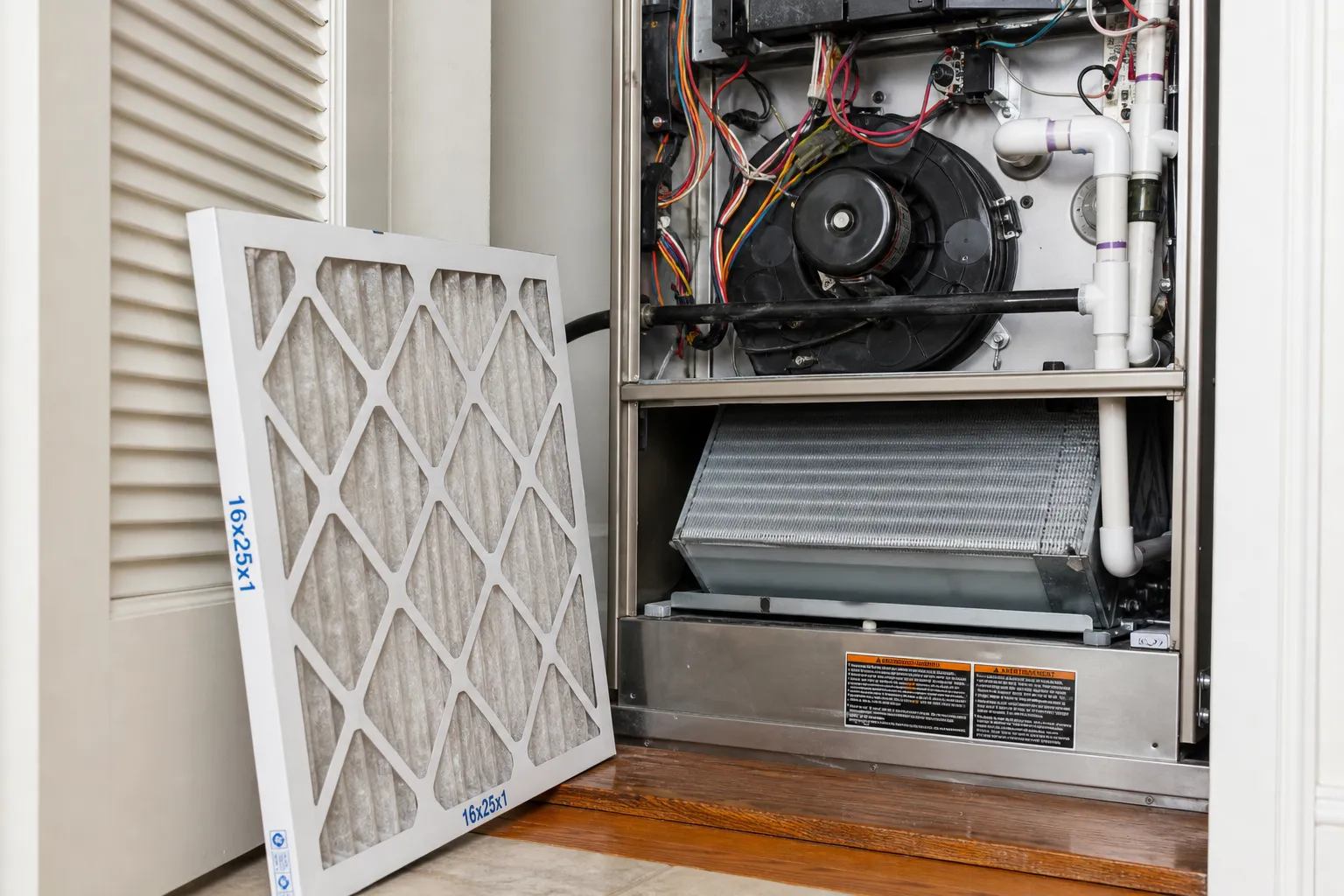
Cost of a filterNot enough air across the indoor coil drops pressures and temperatures until a safety control intervenes, or the coil begins to freeze. The cheapest item on this page and the first thing worth checking.
Low refrigerant from a leak
$400 – $1,600As charge falls, suction pressure drops far enough to trip the low pressure switch. The system stops, pressure equalizes, it starts again and repeats. Refrigerant is never consumed, so low always means a leak. More on leak detection.
A weak run capacitor
$150 – $350A capacitor drifting out of tolerance makes the compressor strain on every start, drawing high current and heating up until its internal overload trips. It cools, resets, and tries again. One reading in microfarads confirms it. More on capacitors.
A frozen evaporator coil
Depends on causeIce restricts airflow and pressures until the system shuts down, then partially thaws and restarts. If you have found ice anywhere on the copper lines, deal with that first. Start with the frozen coil page.
A control board or relay fault
$400 – $900Less common, but a failing board or intermittent relay can interrupt the call for cooling erratically. Most boards flash a diagnostic code, which is the first thing a technician should be reading rather than guessing at.
A system that is simply too large
See belowThe uncomfortable one, because there is no repair. An oversized system reaches setpoint too fast to complete a proper cycle, and it will do that for its entire life. Covered properly in the next section.
The honest one
Sometimes nothing is broken and that is the problem
Oversizing is common in Fresno, because "it gets to 108 here, put in a bigger one" sounds like sensible advice and is not. A system sized beyond what the house actually needs blasts the thermostat to setpoint in a few minutes, shuts off, and repeats all summer.
You get cooling, so it does not feel like a fault. What you also get is a compressor accumulating starts three times faster than it should, a house that feels clammy because the system never runs long enough to remove moisture, and rooms that never even out because air stops moving before it has circulated.
There is no part to replace. The honest options are to live with it knowing the compressor will not go the distance, to improve what you can around it, or to size it correctly next time. We would rather tell you that than sell you a repair that changes nothing.
Signs your system was oversized rather than broken
- It has short cycled since the day it was installed, not since something changed
- The house cools quickly but feels damp or clammy afterwards
- More than one technician has measured it and found nothing wrong
- Nobody performed a load calculation before it was installed
- The tonnage was chosen by matching whatever was there before
Common questions
What is AC short cycling?
It means the system starts, runs for only a few minutes, shuts off and restarts repeatedly. As a working threshold, run times consistently under ten minutes several times an hour indicate short cycling, while fifteen minutes or more is healthy. The problem is not the stopping itself but the number of compressor starts it produces.
How long should an AC run per cycle?
Roughly fifteen to twenty minutes in moderate conditions is typical for a correctly sized system. On an extreme Fresno afternoon a healthy system may run continuously, and that is a good sign rather than a fault. What matters is the pattern across several cycles rather than any single one.
Why is short cycling bad if the house is still cooling?
Because compressors wear out on starts rather than on run hours. Starting draws several times the current of steady running, and that inrush is where the stress lives. A system starting six times an hour instead of twice is aging its most expensive component roughly three times faster, while also using more energy and dehumidifying poorly.
Can a thermostat cause short cycling?
Yes, and it is one of the more common causes. A thermostat in afternoon sun, on an exterior wall, above a lamp or television, or in the path of a supply vent reads a temperature the rest of the house is not experiencing. It satisfies early, shuts down, warms quickly and calls again. Relocation is sometimes the entire fix and costs very little.
Is my AC too big for my house?
Possibly, and it is common in Fresno where oversizing gets recommended as insurance against extreme heat. The clearest sign is that it has short cycled since installation rather than since something changed, cools quickly but leaves the house feeling clammy, and has been measured by technicians who found nothing wrong. Oversizing cannot be repaired, only corrected at replacement.
How much does it cost to fix short cycling?
It depends entirely on the cause. Relocating a thermostat or replacing a filter costs very little. A thermostat replacement runs $175 to $500, a capacitor $150 to $350, a refrigerant leak repair $400 to $1,600 and a control board $400 to $900. A dirty condenser coil is resolved during maintenance. An oversized system has no repair. See published repair pricing.
Should I keep using it while it short cycles?
You can, but it is worth diagnosing rather than living with. Every cycle is compressor life you do not get back, and several of the causes are inexpensive to fix. If the cycles are getting noticeably shorter over days rather than months, or cooling is weakening at the same time, have it measured sooner rather than later.
Got your cycle times?
Tell us the number when you call. We measure pressures, airflow and capacitance to establish which of the three reasons it is.
Guidance on this page is general information and not a substitute for a professional diagnosis. Cycle length ranges are general guidance and vary with system type, outdoor conditions and home construction. Prices shown are typical ranges for the Fresno area and are not quotes. California Heating & AC Repair is operated by Craftline Renovations, Inc. · CSLB License #999179 · Licensed and insured.