Blower motor repair & replacement
No air from the vents?Everything else is irrelevant.
Your blower is the only component that works all twelve months. It moves the cold air in July and the warm air in January, and when it stops, a perfectly healthy system delivers nothing at all.
Worth understanding
One motor, both seasons, twice the wear
Most people picture their heating and cooling as two separate systems. Mechanically they mostly are — except for the blower. The same motor and the same wheel push air through the same ducts whether the air was chilled by an evaporator coil or warmed by a furnace.
That means it logs hours in July and again in January, and it is the one component where a failure takes out heating and cooling together. It also means anything restricting airflow — a filter, a duct, a closed register — is working against it every single month of the year rather than seasonally.
When a blower fails, you do not have an air conditioning problem or a heating problem. You have both.
Signs it is the blower
Six symptoms that point at the indoor motor rather than anything outside.
No air at all from any vent
The outdoor unit may be running perfectly. If nothing is moving indoors, nothing reaches the house regardless.
Squealing or grinding indoors
Bearings failing in the motor, or a blower wheel out of balance. The squeal usually comes weeks before the grind.
Weak airflow that has been worsening
A motor losing speed or straining against restriction delivers less air each season until someone measures it.
It runs, stops, then runs again
A motor overheating and tripping its internal protection, cooling down and restarting. Common on a motor working too hard.
A burning or hot electrical smell
Switch the system off at the breaker and call. A motor overheating badly enough to smell should not be running.
Neither heating nor cooling works
Two systems failing at once almost always means one shared component, and the blower is the one they share.
Two kinds of blower motor, very different prices
This is the single biggest reason blower quotes vary so much, and it is worth knowing which one you have before anyone gives you a number.
Conventional
PSC motor
Lower end of the range
Found in
Most older Fresno systems, and current entry-level equipment.
How it runs
Fixed speeds selected by which wire is connected. Full speed or nothing.
Needs a capacitor
Yes, and we replace it with the motor as standard.
Replacement part
Inexpensive and widely available. Properly specified universal motors work well here.
Variable speed
ECM motor
Upper end of the range
Found in
Higher-efficiency and variable-speed systems, generally newer installations.
How it runs
Continuously variable, adjusting speed to maintain airflow. Quieter and far more efficient.
Needs a capacitor
No. Its electronics handle what a capacitor does on a PSC.
Replacement part
Substantially more expensive, often brand-specific, and sometimes repairable in part rather than whole.
Ask this question
On an ECM, the whole motor is not always the answer
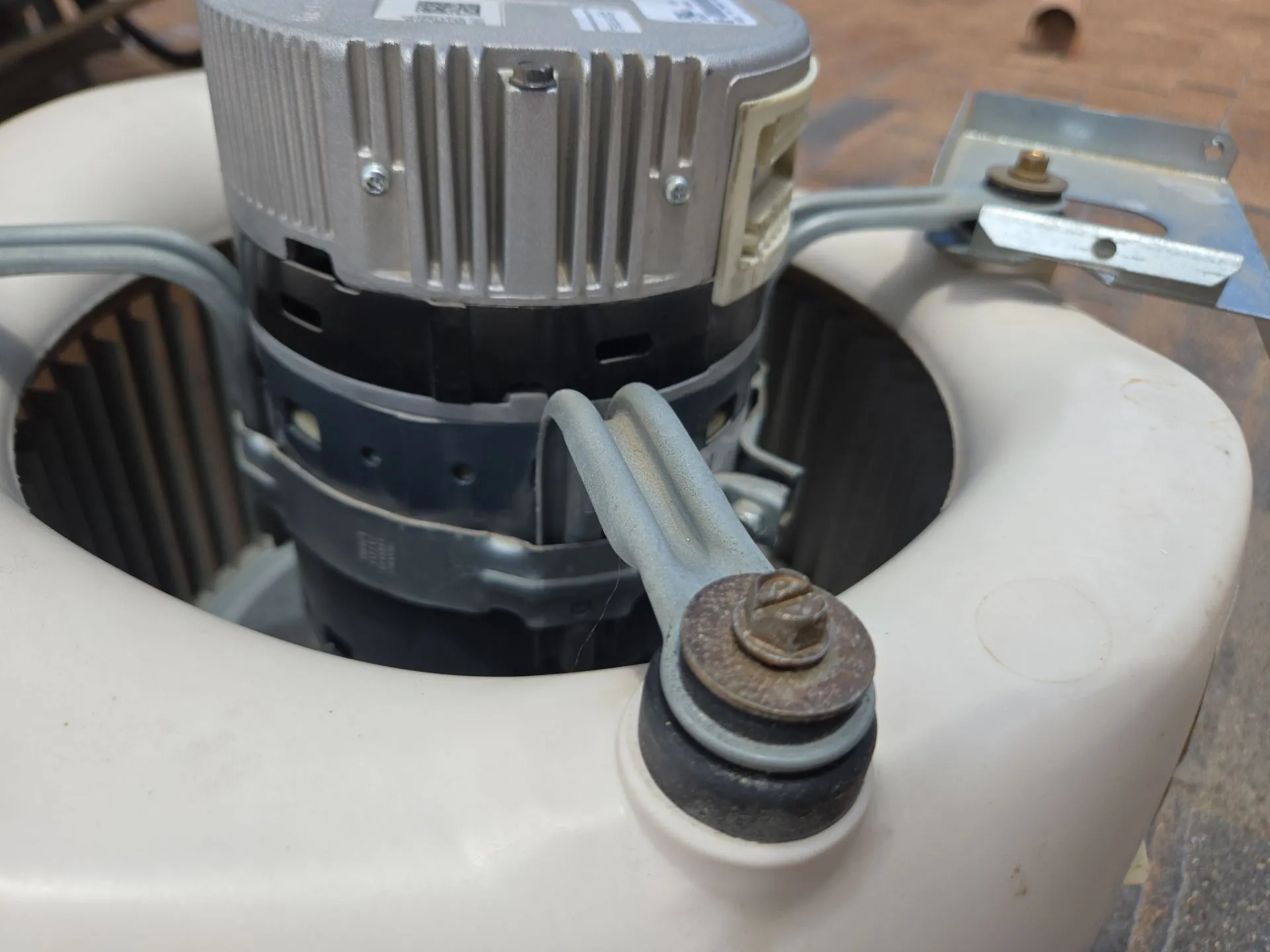
An ECM blower is two things bolted together: the motor itself, and a control module that drives it. They fail independently, and the module fails more often than the motor does.
On many models the module can be replaced on its own, at a meaningfully lower cost than the complete assembly. Whether that applies depends on the manufacturer and the model, and it is a question worth asking rather than assuming.
A company that quotes a complete ECM assembly without telling you the module was an option has not necessarily done anything wrong. But you were entitled to know, and now you do.
What to ask about an ECM quote
- Is it the motor or the module? They are tested separately and they fail separately.
- Can the module be replaced alone on this particular model, and what does that cost against the full assembly?
- Is the motor still under manufacturer warranty? On newer equipment it frequently is, which changes the number entirely.
- What was the static pressure reading? If nobody measured it, nobody knows why the motor failed.
Blower motors rarely die of old age
Something usually kills them, and if that something is not found, it will kill the replacement on the same schedule.
-
High static pressure
The most common underlying cause and the one nobody checks. A motor pushing against a restricted duct system works far harder than it was designed to, runs hotter, and wears out years early. Measured with a manometer, and it is the reading that tells you whether this will happen again. More on airflow.
-
Filters left too long
Fresno dust loads filters faster than the packaging suggests. A blocked filter is a restriction the motor fights on every cycle, twelve months a year, and it is the cheapest thing on this list to prevent.
-
A dirty blower wheel
Dust building up in the wheel's blades unbalances it and reduces how much air it moves. The imbalance destroys bearings, and the reduced airflow makes the motor run longer to do the same job.
-
Closed registers and blocked returns
Closing vents in unused rooms feels efficient and raises static pressure across the whole system. Furniture over a return does the same thing. Duct systems are balanced as a whole rather than room by room.
-
A failed capacitor left in place
On a PSC motor, a capacitor drifting out of tolerance makes it strain on every start. The motor survives that for a while, and then it does not. This is exactly what an annual capacitance reading catches. What a tune-up covers.
-
Heat and run hours
Attic and closet installations run hot in a Fresno summer, and our systems accumulate far more operating hours per season than the national average. Both shorten motor life compared with milder climates.
The measurement that matters: total external static pressure. If a company replaces your blower motor without measuring it before and after, they have replaced a part rather than solved a problem, and you will likely meet them again.
What a proper replacement includes
Half the early failures we see on previously replaced blowers trace back to something here being skipped.
- Static pressure measured before the work, to establish why it failed
- Motor and module tested separately on an ECM system
- Warranty status checked against model and serial before quoting
- Correct horsepower, speed, rotation, frame and shaft diameter
- Blower wheel cleaned, or replaced if it is damaged or out of balance
- New capacitor fitted with any PSC motor, as standard
- Wheel correctly positioned on the shaft and set screw properly torqued
- Speed tap or programming set to deliver the correct airflow for your system
- Amp draw verified against the data plate under load
- Static pressure and temperature split measured again afterwards
If the static pressure reading is still high after a new motor is fitted, you have a duct problem wearing out motors. We will tell you that rather than book you in again next year.
What it costs
The spread here is wider than most repairs
Blower motor replacement in the Fresno area typically falls in the range below, including diagnosis, the motor, a new capacitor where the system uses one, and verification afterwards.
A conventional PSC motor with reasonable access sits near the bottom. An ECM variable-speed motor sits near the top, because the part itself costs several times more. Attic installations add labor, and an ECM still under manufacturer warranty can land well below the range because you are paying labor only.
Blower motor questions
How much does blower motor replacement cost in Fresno?
Typically $600 to $1,300, including diagnosis, the motor, a capacitor where the system uses one, and verification afterwards. A conventional PSC motor sits near the bottom of that range and an ECM variable-speed motor near the top, since the part costs several times more. If the motor is still under manufacturer warranty you pay labor only, which lands well below the range.
What is the difference between a PSC and an ECM blower motor?
A PSC motor runs at fixed speeds selected by wiring and requires a capacitor. An ECM motor varies its speed continuously to maintain airflow, is significantly quieter and more efficient, and needs no capacitor. ECM parts cost considerably more, which is the main reason blower quotes vary so widely. Your data plate or your technician can tell you which you have.
Can an ECM blower motor be repaired instead of replaced?
Sometimes, and it is worth asking. An ECM is a motor plus a control module, they fail independently, and the module fails more often. On many models the module can be replaced on its own for meaningfully less than the complete assembly. Whether that applies depends on manufacturer and model, so ask specifically whether the fault is the motor or the module.
Why did my blower motor fail?
Usually because it was working against restricted airflow. High static pressure from a blocked filter, undersized or crushed ducting, closed registers or a blocked return makes the motor work far harder than designed. A dirty blower wheel, a weak capacitor on a PSC motor, and Fresno's heat and run hours all contribute. The static pressure reading is what tells you whether it will happen again.
Can I still run my AC if the blower is not working?
You will get nothing from it, and it is better to turn the system off. Without airflow across the indoor coil, the coil will freeze and running the compressor into a frozen coil causes expensive damage. On the heating side, no airflow means a furnace overheating and tripping its limit switch repeatedly. Switch it off at the thermostat.
Does a blower motor affect heating as well as cooling?
Yes, and this is the important part. The blower is the one component shared between the two systems, moving air through the same ducts whether it was cooled by the evaporator coil or warmed by the furnace. A blower failure takes out heating and cooling together, and if neither is working that is usually where to look first.
How long does the repair take?
Usually two to four hours when the correct motor is available, longer in a tight attic or where the blower assembly has to come out entirely. Common PSC motors are frequently stocked. ECM and brand-specific motors often need ordering, and we will give you a realistic timeline rather than an optimistic one.
Find out why it failed, not just that it did
Static pressure measured, motor and module tested separately, warranty checked, and a firm price before anything is touched.
Prices shown are typical ranges for the Fresno area and are not quotes. Manufacturer warranty terms vary by brand, model and registration status. California Heating & AC Repair is operated by Craftline Renovations, Inc. · CSLB License #999179 · Licensed and insured.