
AC leaking water
The repair is cheap.The ceiling is not.
This is the one fault where the damage to your house routinely costs more than fixing the fault. It is also the one where the system usually keeps cooling perfectly, which is exactly why people leave it. Turn it off and read the three steps below.
Do this now
Three steps, and the first one stops the water at the source rather than mopping up after it.
1
Turn cooling off — that stops the water
Set the mode to OFF, and leave the fan on AUTO rather than ON. Do not just raise the temperature.
Why this actually helps: the water is condensation your system is producing right now. Stop cooling and you stop making it, which stops the leak at source within minutes. This is the opposite of what you do for a frozen coil, where the fan on ON speeds up a thaw — here you want the whole thing quiet.
2
Protect what is underneath
Towels and a bucket under the drip. If the unit is in an attic and water is coming through a ceiling, move furniture and electronics out from under it now rather than later.
Why the urgency: a saturated ceiling can come down without much warning, and drywall holds a great deal of water before it shows. If you can see staining or a sagging bulge, treat the area underneath as unsafe and stay out of it.
3
Look at the drain pan, without touching anything
If you can safely see the indoor unit, look at the shallow pan beneath the coil. Is it holding standing water? Is the drain line coming off it wet along its length, or dry?
Why we ask: standing water in the pan with a dry drain line points squarely at a blockage, which is the most common cause and the cheapest fix. Tell us what you saw when you call — it genuinely shortens the visit. Do not open panels or poke at anything.
First, some context
Your AC is supposed to make water
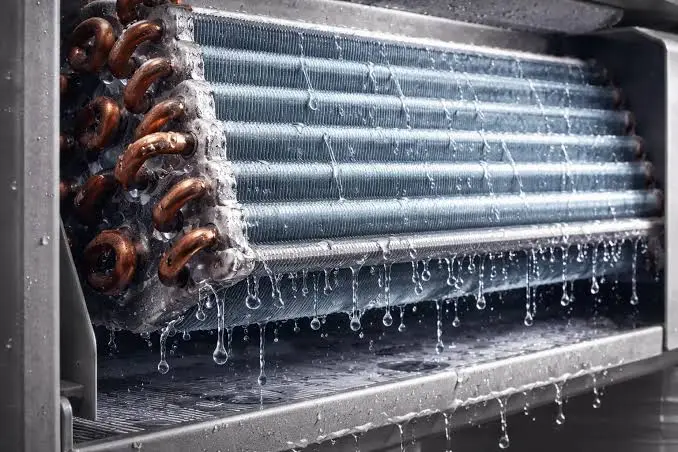
Cooling works by pulling heat out of indoor air across a coil that sits below the dew point. Moisture in the air condenses on that coil, exactly like a cold glass on a summer afternoon, and runs off into a pan and out through a drain line.
On a hot day a residential system produces gallons of it. That is normal and it is a sign the system is doing its job. The fault is never that water exists — it is that the water has found a route other than the drain.
Which is why almost every case on this page comes back to the drainage system rather than the air conditioner itself.
Normal, or not?
- Normal: a steady drip or trickle from the drain pipe outside, where it terminates. That is the system working correctly.
- Normal: a damp patch on the ground beneath that outdoor drain termination on a hot day.
- Not normal: any water inside the house, around the indoor unit, or in the closet or garage where it sits.
- Not normal: staining, bubbling paint or a sagging patch on a ceiling below an attic unit.
- Not normal: water dripping from a pipe that only started dripping recently, particularly near a window.
Where the water is tells you most of the story
Four places people find it, and what each one means. One of them is fine, one is a warning you should not miss.
Around the indoor unit, in a closet or garage
Act nowThe most common presentation. Water is overflowing the drain pan rather than leaving through the drain line, which almost always means a blockage, a cracked pan, or a drain line that has come apart or lost its slope. Cheap to fix and it will not stop on its own.
Through a ceiling, below an attic unit
Act nowThe expensive version of the same fault. By the time water shows on a ceiling, the drywall above has already absorbed a great deal, and the insulation in that bay is probably saturated. Turn the system off, keep out from underneath, and call rather than waiting to see whether it gets worse.
From a pipe above a window or eave, dripping
Warning signThis one is worth understanding, because it is a message rather than an accident. Many homes with attic air handlers have a secondary drain line that terminates somewhere deliberately conspicuous, often above a window. It stays dry for years. It only runs when the primary drain has blocked and the emergency pan is catching the overflow. If that pipe is dripping, your primary drain is already blocked and the ceiling is next.
At the outdoor unit, on the ground
Usually fineGenerally nothing to worry about. In many installations the condensate drain terminates outside near the condenser, so a wet patch on a hot afternoon is the system doing exactly what it should. Worth a second look only if the volume seems unusual or you also see ice on the copper lines, which is a different problem. More on frozen coils.
What is actually causing it
Ordered by how often we find each one. Costs are typical Fresno ranges, not quotes.
A blocked condensate drain line
$125 – $300The cause in most cases we attend. Dust, biological growth and Valley debris build a plug inside the line over a season, water backs up into the pan, and the pan overflows. Cleared, flushed and the float switch tested, and it is done.
A failed or missing float switch
Part of drain workThe safety device that shuts the system down when the pan fills. When it works, you get an air conditioner that mysteriously stopped instead of a damaged ceiling — which is the better problem. When it is missing, stuck or was bypassed by someone, nothing stops the overflow. More on systems that shut themselves off.
A rusted or cracked drain pan
Quoted after diagnosisOlder metal pans corrode from years of sitting damp. Once a pan is holed, water leaves before it ever reaches the drain. Replacement cost varies considerably with access and whether the coil has to come out to reach it.
A disconnected or badly sloped drain line
Quoted after diagnosisDrain lines rely entirely on gravity. A line that has sagged, been knocked loose in an attic, or was never given enough fall will hold water and back up. Frequently an installation issue rather than a failure, and it tends to appear on systems that have leaked repeatedly.
A frozen coil that thawed
Depends on causeA heavily iced coil holds several gallons, and when it melts the drain cannot cope with the volume. If you found ice before you found water, the freeze is the real problem and the water was a consequence. Start with the frozen coil page.
A dirty air filter
Cost of a filterIndirect but genuinely common. Restricted airflow drops the coil below freezing, ice forms, ice melts, and the drain floods. The water is the symptom of the symptom, and a filter is the actual fix.
A failed condensate pump
Quoted after diagnosisWhere the unit sits below the drain point, a small pump lifts the water out. When the pump fails or its reservoir blocks, the water has nowhere to go. These have a limited service life and are a routine replacement.
Missing insulation on the refrigerant line
Small repairNot a drain fault at all. The larger copper line runs cold, and where its insulation is missing or has degraded, condensation forms directly on the pipe and drips. Common on older installations and easy to correct once identified.
Why this one is worth calling about today
Most HVAC faults get more expensive slowly. This one gets more expensive by the hour, and the cost lands on your house rather than your equipment.
Fixing the fault
$125 – $300
Clearing a blocked condensate drain, flushing the line and testing the float switch.
versus
Fixing the house
Four figures, easily
Drywall, insulation, paint, flooring, and remediation if growth has taken hold in a wet cavity.
The trap is that the air conditioner usually carries on cooling beautifully while this happens. There is no loss of comfort telling you to act, so it gets left until a ceiling stain appears — by which point the cheap repair is still cheap and the expensive one has already started.
If your unit is in the attic
Know where your secondary drain terminates
California installations with an air handler in an attic generally have two layers of protection: an emergency drain pan under the unit, and a secondary drain line running from it to somewhere you will notice. That is deliberate design, and it only works if you know what you are looking at.
- Find it before you need it. Look for a small pipe stub through the eave or exterior wall, often positioned above a window.
- It should never run. Water from it is not a leak in that pipe — it is the emergency pan doing its job because the primary drain has failed.
- Treat it as a countdown. The emergency pan buys you time, not immunity. It has a finite capacity and its own drain can block too.
- If you cannot find one, mention it when we visit. Some older attic installations were never fitted with secondary protection, and adding it is inexpensive insurance.
Common questions
Why is my AC leaking water inside the house?
Almost always a drainage problem rather than a fault with the air conditioner itself. The most common cause is a blocked condensate drain line, followed by a failed float switch, a rusted or cracked drain pan, a disconnected or badly sloped drain line, a frozen coil that has thawed, or a failed condensate pump. Missing insulation on the refrigerant line also causes dripping that looks like a leak.
Should I turn my AC off if it is leaking water?
Yes. The water is condensation the system is producing right now, so turning cooling off stops the leak at source within minutes. Set the mode to OFF and leave the fan on AUTO. This is the opposite of the advice for a frozen coil, where running the fan speeds up a thaw.
Is it normal for my AC to drip water outside?
Yes. The condensate drain often terminates outside near the condenser, so a steady drip and a damp patch on a hot day is the system working correctly. A residential system produces gallons of condensate on a Fresno afternoon. Water inside the house is the problem, not water outside it.
How much does it cost to fix an AC water leak?
Clearing a blocked condensate drain typically runs $125 to $300 in the Fresno area, including flushing the line and testing the float switch. Drain pan replacement, line repairs and condensate pumps are quoted after diagnosis because access varies enormously. See published repair pricing.
My AC is leaking but still cooling fine. Can it wait?
This is the trap with this particular fault. The system usually does keep cooling normally, so nothing about your comfort tells you to act, while water continues accumulating in drywall, insulation and framing. The repair stays cheap. The damage does not. It is worth dealing with in days rather than weeks.
Water is dripping from a pipe above my window. What is that?
That is almost certainly your secondary condensate drain, and it is a warning rather than a fault in that pipe. It runs from the emergency pan beneath an attic air handler and is deliberately placed where you will see it. If it is dripping, your primary drain has blocked and the emergency pan is catching the overflow. Turn the system off and call.
Can I pour bleach down the drain line myself?
We would not recommend it. Bleach can corrode the metal drain pan and some components, and pouring anything into a line that is already fully blocked simply adds to what is sitting there. A proper clearing removes the blockage rather than trying to dissolve it, and takes the opportunity to check the pan, the slope and the float switch at the same time.
Get it cleared before it reaches anything expensive
Drain cleared and flushed, pan and slope checked, float switch tested, and a photo of what was in there.
Guidance on this page is general information and not a substitute for a professional diagnosis. Prices shown are typical ranges for the Fresno area and are not quotes. Water damage remediation and drywall repair are outside our scope. California Heating & AC Repair is operated by Craftline Renovations, Inc. · CSLB License #999179 · Licensed and insured.