
AC making loud or unusual noise
Find your sound.It tells us where to look.
Air conditioners fail in acoustically distinctive ways. A screech is not a rattle and neither is a bang, and each one points at a different component. Three of them mean shut it off right now — those are first.
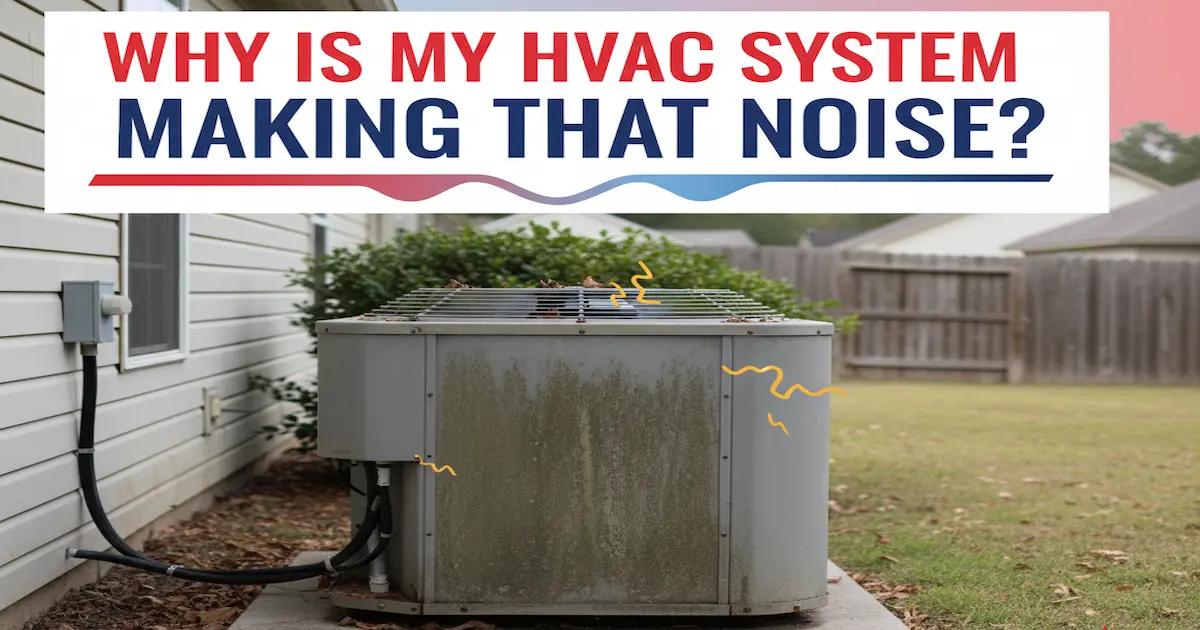
Three sounds that mean switch it off now
Not later today. These are the noises where every additional minute of running turns a repair into a replacement.
Grinding, metal on metal
Bearings have failed, or something is contacting a moving part. Running it wears through what is left and can seize the motor entirely.
Banging or violent clanking
Something has come loose inside the compressor, or a fan blade is striking the housing. Both destroy expensive parts very quickly.
Screaming, or a high-pitched shriek
On a sealed system this can indicate dangerously high internal pressure. Switch off at the thermostat and the breaker and stay away from the unit.
How to switch off properly: set the thermostat to OFF, then switch off the outdoor unit at its disconnect or breaker if you can do so safely. Then call. The house getting warm is a much smaller problem than the one currently making that noise.
What each sound actually means
Nine sounds we get called about, what causes each one, how urgent it is and roughly what it costs. Costs are typical Fresno ranges rather than quotes.
Grinding or scraping
Shut it offSounds like: metal dragging on metal, a rough continuous rasp, worse as it runs.
Motor bearings that have failed and are now running dry, or a fan blade contacting its shroud. On the indoor side it is usually the blower motor; outdoors it is the condenser fan. Once bearings are gone, continuing to run it takes the motor and sometimes the blade with it.
Banging or heavy clanking
Shut it offA loose or broken component inside the compressor, an unbalanced blower wheel, or a fan blade striking something. If the sound is rhythmic and matches the speed of a spinning part, something is hitting something else on every rotation. More on compressors.
Sounds like: a heavy thud or clang, often repeating in time with the fan.
Screeching or squealing
SoonSounds like: a high metallic squeal, sometimes only on startup, sometimes constant.
Bearings beginning to fail in the blower or condenser fan motor, or on older equipment a worn belt. This is the warning shot that comes before grinding — a motor caught at the squeal stage is often just a motor, whereas one caught at the grinding stage has usually taken other things with it.
Buzzing or loud electrical humming
SoonSounds like: a persistent electrical buzz from the outdoor unit, often with nothing spinning.
Most commonly a failed run capacitor leaving the compressor straining to start, or a contactor whose coil is failing. Also produced by loose wiring. If the unit buzzes but nothing turns, that is close to a textbook capacitor symptom and it is the cheapest repair on this page. More on capacitors.
Rapid clicking or chattering
SoonSounds like: a fast repeated click from the outdoor unit, or a relay tapping rapidly.
A contactor pulling in and dropping out repeatedly, usually from pitted contacts, a weak coil or low control voltage. Each of those cycles arcs the contacts a little further, so it gets worse rather than settling down. A single click when the system starts or stops is completely normal.
Hissing
SoonSounds like: a steady hiss, sometimes from the indoor unit, sometimes near the copper lines.
Two very different causes. A refrigerant leak large enough to hear, or air escaping from a duct connection under pressure. The refrigerant version usually comes with cooling that has been getting weaker for weeks. Refrigerant is never consumed, so if you are low, something is letting it out. More on leak detection.
Bubbling or gurgling
SoonSounds like: liquid moving, or an intermittent glug from the indoor unit.
Either the condensate drain struggling to clear, or air that has entered the refrigerant circuit through a leak. The drain version often arrives alongside water where it should not be, and it is inexpensive to resolve. More on AC water leaks.
Rattling or vibrating
Often cheapSounds like: a loose panel buzzing, or something skittering inside the outdoor unit.
Frequently the least serious sound on this list and sometimes free to fix. Loose service panel screws, twigs and Valley debris inside the condenser, a unit no longer sitting level on its pad, or worn vibration isolation. Occasionally it is an early sign of a loose blower wheel, which is why it still deserves a look.
Whistling from the vents
Airflow issueSounds like: air being forced through a narrow gap, worst at a particular register.
Not an equipment fault at all — it is air moving too fast through too small an opening. Blocked filter, closed registers, an undersized or blocked return, or crushed ducting. High static pressure shortens blower life and can freeze the coil, so the whistle is worth listening to even though nothing is broken yet.
Indoor or outdoor narrows it further
Same sound in two locations means two different components. Worth establishing before you call, because it genuinely shortens the visit.
From the indoor unit
Furnace, air handler, closet, attic or garage
- Blower motor and its bearings
- Blower wheel out of balance or loose on the shaft
- Condensate drain or pump
- Ductwork expanding, or panels vibrating
From the outdoor unit
The condenser beside the house
- Compressor
- Condenser fan motor and blade
- Capacitor and contactor, in the electrical compartment
- Debris in the cabinet, or the pad settling out of level
Also worth noting: does it happen only at startup, only at shutdown, or the whole time it runs? A startup-only noise usually points at something struggling to get moving. A constant one points at something already worn.
Before you worry
Some noises are the system working properly
Air conditioners are machines with motors, refrigerant and moving air, and none of that is silent. Several perfectly normal sounds get mistaken for faults, particularly on a newer system in a quiet house.
The signal that matters is change. A noise your system has always made is far less interesting than one that started last week, got louder, or arrived alongside weaker cooling.
If you cannot tell whether yours is new, call and describe it. We answer questions on the phone for free, including from people who turn out not to need us.
Normal, in most cases
- A single click as the system starts and again as it stops. That is the contactor doing its job.
- A steady low hum from the outdoor unit while it runs.
- A whoosh of air building for a few seconds when the blower starts.
- Occasional ticking or popping from ductwork as metal expands and contracts with temperature.
- A brief gurgle from the condensate line as it clears.
Why this page matters
A noise is the cheapest warning your system will ever give you
Most air conditioning failures announce themselves before they happen, and sound is usually how. Bearings squeal for weeks before they grind. A capacitor buzzes before it strands you. A blower wheel rattles before it comes loose.
The difference between acting on the squeal and acting on the grind is frequently the difference between one component and three. Nobody enjoys calling about a noise when the house is still cool, which is exactly why the expensive version of this repair is so common in Fresno every July.
Your system is telling you something while the repair is still small. That is a genuinely useful thing and it costs nothing to listen.
Common questions
Why is my AC making a loud noise?
It depends entirely on the sound. Grinding and banging usually mean failed bearings or a loose component and require shutting the system off immediately. Screeching points at bearings beginning to fail. Buzzing is most often a failed capacitor or contactor. Rattling is frequently loose panels or debris and is often minor. Hissing suggests a refrigerant leak or a duct connection, and whistling from vents indicates restricted airflow rather than an equipment fault.
Should I turn my AC off if it is making a noise?
Yes for grinding, banging or any high-pitched screaming. Those sounds mean parts are being destroyed while it runs, and every extra minute increases what needs replacing. For rattling, buzzing or clicking you can usually wait for an appointment, though buzzing with nothing spinning means the compressor is straining and is better switched off.
My AC buzzes but does not start. What is that?
Close to a textbook failed run capacitor. The compressor is receiving power and trying to start but cannot get the torque it needs, so it draws current and hums. It is confirmed by measuring capacitance in microfarads and is the cheapest common repair, typically $150 to $350 in the Fresno area. A pitted contactor and low supply voltage produce the same symptom.
Is it normal for an AC to click when it starts?
Yes. A single click at startup and another at shutdown is the contactor opening and closing, and it is completely normal. What is not normal is rapid repeated clicking or chattering, which suggests a contactor with pitted contacts, a failing coil or low control voltage.
How much does it cost to fix a noisy AC?
It varies enormously with the cause. A capacitor is typically $150 to $350, a contactor $150 to $300, a condenser fan motor $400 to $800, a blower motor $600 to $1,300 and a refrigerant leak repair $400 to $1,600. Loose panels and debris are often minor. Compressor faults are quoted after diagnosis. See published repair pricing.
My AC has always been noisy. Should I worry?
Change is what matters more than volume. A system that has sounded the same for five years is far less concerning than one that developed a new sound last week or got noticeably louder. If a noise arrived alongside weaker cooling, higher bills or shorter run cycles, it is worth having measured regardless of how long it has been there.
Can a noisy AC be dangerous?
Most noises are a mechanical problem rather than a safety issue, but some warrant caution. A high-pitched shriek from a sealed system can indicate excessive internal pressure and the unit should be switched off and left alone. Any burning or electrical smell alongside a noise means shutting off at the breaker. If you smell gas at any point, leave the building and call 911 or your gas utility from outside.
Tell us what it sounds like
Describe it on the phone and we will tell you whether it can wait. Then measure it properly rather than guess.
Guidance on this page is general information and not a substitute for a professional diagnosis. Prices shown are typical ranges for the Fresno area and are not quotes. Do not open the electrical panel on your outdoor unit — capacitors retain a charge after power is disconnected. California Heating & AC Repair is operated by Craftline Renovations, Inc. · CSLB License #999179 · Licensed and insured.